This move will enable it to incur higher-than-mandated borrowing, and possibly spending, till the 2024 Lok Sabha election cycle.

Indian benchmark indices Sensex and Nifty experienced significant declines in early trade, driven by soaring crude oil prices amidst escalating tensions in West Asia, coupled with weak global market trends and foreign fund outflows.

A high-level committee, including representatives from banks and payment associations, is set to decide on Merchant Discount Rate (MDR) for UPI transactions exceeding Rs 2,000 to merchants. While person-to-person and person-to-merchant transactions up to Rs 2,000 remain free, the move follows a recent amendment to the Payment and Settlement Systems Act, sparking debate and clarification from the Finance Minister that only certain high-value merchant transactions might incur charges.

The Congress party has criticised the government's recent notification regarding UPI transactions, alleging it paves the way for users to be charged fees, particularly for transactions above Rs 2,000. The party claims the government lacks transparency and questions if the move is to benefit American firms. The government, however, states that charges are necessary for the system's sustainability and infrastructure upgrades, with the Finance Minister clarifying that Merchant Discount Rate (MDR) applies to merchants, not customers.
The Rajya Sabha has passed The Bankers' Books Evidence Bill, 2026, which aims to replace a British-era law and allow digital and virtual records to be admissible as evidence in courts. This legislation aligns with contemporary digital banking practices and extends a uniform evidential framework to various financial entities, including NBFCs and fintech companies. Finance Minister Nirmala Sitharaman highlighted the bill's role in strengthening public confidence and safeguarding customer privacy. The bill's passage, however, saw an Opposition walkout over unrelated issues.

The Indian government has introduced a 0.4% Merchant Discount Rate (MDR) on UPI person-to-merchant (P2M) transactions exceeding Rs 2,000, effective October 15. This move ends nearly six years of fully free UPI payments, though person-to-person (P2P) transfers and small P2M payments remain free. The charges aim to bolster investment in UPI infrastructure, with specific exemptions and caps for essential sectors.

The Centre has spent 28 per cent of its FY27 capital expenditure budget of Rs 12.21 trillion in the first three months against around 24.5 per cent during the corresponding period a year ago.

The government had on Wednesday faced major embarrassment in the Rajya Sabha as five amendments moved by the Congress and the CPI-M to the Finance Bill were adopted and approved by the House.

The government came in for a scathing attack in the Lok Sabha on Monday from friends and foes alike over handling of the economy.

The amendment of around 40 central statutes makes the Finance Bill, 2017 unique

The Opposition on Monday charged the government with trying to promote crony capitalism, creating fear by giving "unbridled power" to taxmen, trying to snoop into people's lives through increased use of Aadhaar through the provisions of the Finance Bill.
India's MSME sector faces a significant formal credit gap of approximately Rs 60 lakh crore, with traditional channels meeting only a fraction of the demand. A new report suggests that a centralised, interoperable digital layer could effectively bridge this gap and enhance productivity across the formal business sector by digitising workflows and enabling cash-flow-based underwriting.

Jharkhand's Finance Minister has ordered a statewide investigation into alleged fraudulent salary withdrawals from government treasuries, following reports of irregularities in multiple districts.

Homegrown software company Zoho has launched Zia Chat, a unified AI interface designed to streamline business operations across various functions. Alongside this, Zoho announced its entry into vertical SaaS with seven industry-specific applications for sectors like retail, automotive, healthcare, and education, reinforcing its position as a 'Swadeshi' alternative to global tech giants.
The Indian government has introduced a 0.4% fee on UPI transactions above Rs 2,000 for merchants, effective October 15, sparking strong opposition from political parties and traders. Despite accusations of foreign influence and demands for a rollback, the finance ministry and top functionaries have stated there will be no reversal, citing the need for a self-sustaining digital payments ecosystem.

The Congress party has accused the Indian government of imposing new charges on UPI transactions due to pressure from the United States, specifically to benefit American card companies. The opposition party demanded the withdrawal of the decision, calling it "anti-national" and alleging it fills the coffers of US firms while burdening Indian citizens. The government, however, clarified that the Merchant Discount Rate (MDR) charges apply only to commercial transactions above Rs 2,000 and are not levied on consumers, a stance supported by the BJP which accused Congress of spreading "fake news".
The annual Finance Bill may soon become far less exciting as the government plans to lift the veil of secrecy surrounding tax proposals in Budget. Once the Direct Taxes Code (DTC) and Goods and Services Tax (GST) are in place, the finance ministry will adopt a public discussion approach for most future decisions, while confining the annual exercise to a few procedural changes.

A two-day weekend would help employees recover physically and mentally. They would return better prepared for branch work that demands patience, judgment, and accuracy, asserts Tamal Bandyopadhyay.
The Congress party has strongly criticised the Modi government's decision to introduce a 0.4% Merchant Discount Rate (MDR) on UPI transactions over Rs 2,000, alleging it is a result of US pressure to benefit American card companies. The party also linked this move to broader US actions against India, including tariffs and H-1B visa issues, coining the term "Narendra's Ongoing Trump Appeasement." The government, however, clarified that consumers will not bear the charge, which applies only to merchants.
The Congress party has accused the Modi government of succumbing to US pressure by introducing a 0.4% Merchant Discount Rate (MDR) on UPI transactions over Rs 2,000 for merchants. The party alleges this move aims to benefit US card companies and links it to broader US actions against India, including tariffs and H-1B visa issues. The government, however, clarifies that consumers will not be charged.
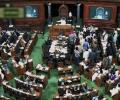
After Finance Minister Arun Jaitley moved the amended Finance Bill for consideration by the Lok Sabha, Deepender Hooda (Congress) said this was a "historic" occasion as never in the past had the Rajya Sabha amended the Finance Bill.
Zoho has launched Zia Chat, a unified AI interface designed to streamline business operations across various functions by providing a single conversational platform for information, lead generation, and data analysis. Concurrently, the company has expanded into vertical SaaS with seven new industry-specific applications for sectors like retail, automotive, healthcare, and education, reinforcing its position as a homegrown alternative to global tech giants.

Govt to scrap 8 appellate tribunals; National Company Law Appellate Tribunal to take over Competition Appellate Tribunal's duties

Several vital parliamentary committees, including those dealing with ethics, rules, and financial matters, are yet to be formally reconstituted. This delay affects the functioning of the Lok Sabha and the oversight of government operations.

India's Central government is likely to see its fertiliser subsidy bill double to a record 3.4 trillion in FY27, up from the Budget estimate of 1.7 trillion, due to surging global fertiliser prices exacerbated by the West Asia war. This significant increase, coupled with revenue losses from excise duty cuts for oil-marketing companies, is straining the government's fiscal space, though capital expenditure plans remain unchanged.

Opposition parties, including Congress, TMC, and RJD, have strongly criticised the government's decision to impose a 0.4% Merchant Discount Rate (MDR) on UPI transactions exceeding Rs 2,000 made to merchants. They allege the move is a result of "American imperialism" and will lead to increased commodity prices, while the government maintains the charge is on merchants and not consumers, with person-to-person transactions remaining free.

The Reserve Bank of India (RBI) has introduced new features for India's digital payment ecosystem, including UPI tap-to-pay for PIN-less transactions up to 5,000 and multi-currency capabilities for forex on Bharat Connect, supporting Euro, British Pound, and other major currencies.
The Indian government has introduced a 0.4% transaction fee on Unified Payments Interface (UPI) payments exceeding Rs 2,000 for merchants, effective October 15, marking the end of nearly six years of free service. Person-to-person transfers and small-value transactions below Rs 2,000 remain free. The new Merchant Discount Rate (MDR) is capped at Rs 300 for transactions above Rs 75,000, with differentiated rates for essential sectors and investments, and safeguards to prevent costs from being passed to consumers.
The opposition has intensified its criticism of the government's decision to impose a 0.4 per cent Merchant Discount Rate (MDR) on UPI transactions above Rs 2,000, effective October 15. Leaders like Rahul Gandhi and Jairam Ramesh allege the move is a result of US pressure, particularly from American card companies, and demand an immediate rollback, warning of increased costs for consumers.
The opposition has strongly criticised the government's decision to introduce a 0.4% Merchant Discount Rate (MDR) on UPI transactions above Rs 2,000 for merchants, effective October 15. They allege the move is a result of US pressure and will lead to increased commodity prices, calling it a "betrayal" of the common man. The government, however, clarifies that customers will not be charged, and the MDR applies only to merchants for larger transactions.
The Congress party has criticised the Modi government over a notification regarding UPI transactions, alleging it paves the way for imposing fees, especially on transactions above Rs 2,000. Rahul Gandhi claimed the government is surrendering to American pressure, while Mallikarjun Kharge highlighted the potential burden on common citizens amidst inflation. The government's notification prohibits charges on UPI transactions up to Rs 2,000 but remains silent on higher amounts, sparking fears of a "Digital Payments Tax."

The Retailers Association of India (RAI) has voiced concerns that the government's new 0.4 per cent Merchant Discount Rate (MDR) on UPI transactions above Rs 2,000 could reverse the progress of digital payment adoption among small retailers. This fee, effective October 15, places the burden on merchants operating on thin margins, potentially pushing them back to cash transactions and undermining the government's formalisation agenda, especially ahead of the festive season.

Arun Jaitley had proposed in the Budget to double the rate of capital gains tax on debt MFs to 20%.

The Payments Council of India has confirmed that Unified Payments Interface (UPI) services will continue to be free for consumers and small merchants, despite a recent Lok Sabha Bill. This clarification addresses concerns about potential charges, emphasising that while a sustainable financial model for UPI infrastructure is being developed, transaction charges will not be passed on to users or small businesses.

Relentless protests by Opposition parties forced the adjournment of the Lok Sabha for the day after the passage of the Bankers' Books Evidence Bill without a debate on Wednesday, with the government accusing them of coming to the House to disrupt proceedings and not for discussion.

The Bharatiya Janata Party received nearly Rs 1,473 crore at its central headquarters alone during the last five state assembly elections, more than seven times the Rs 207 crore in net receipts reported by the Congress across its central and state units, according to expenditure statements filed with the Election Commission.

Urban Indian millennials are caught in an algorithmically amplified consumption spiral where social media normalises spending patterns that systematically undermine retirement security.

The US push for clearer crypto rules is putting pressure on India to fill its own regulatory gap for virtual digital assets.
The National Payments Corporation of India (NPCI) stated that the Merchant Discount Rate (MDR) "is distributed only amongst the UPI ecosystem, to further invest into infrastructure resilience, innovation, cybersecurity (protecting the UPI infrastructure with banks and non-banks) and customer service."

The government is introducing a 0.4% Merchant Discount Rate (MDR) on UPI person-to-merchant payments above Rs 2,000, effective October 15. This move ends the zero-MDR regime, aiming to fund UPI infrastructure and sustainability, as the previous government subsidy was insufficient to cover operational costs. Payments between individuals and most everyday merchant transactions will remain free.
